Verdict: four steps, three hard dependencies, zero shortcuts
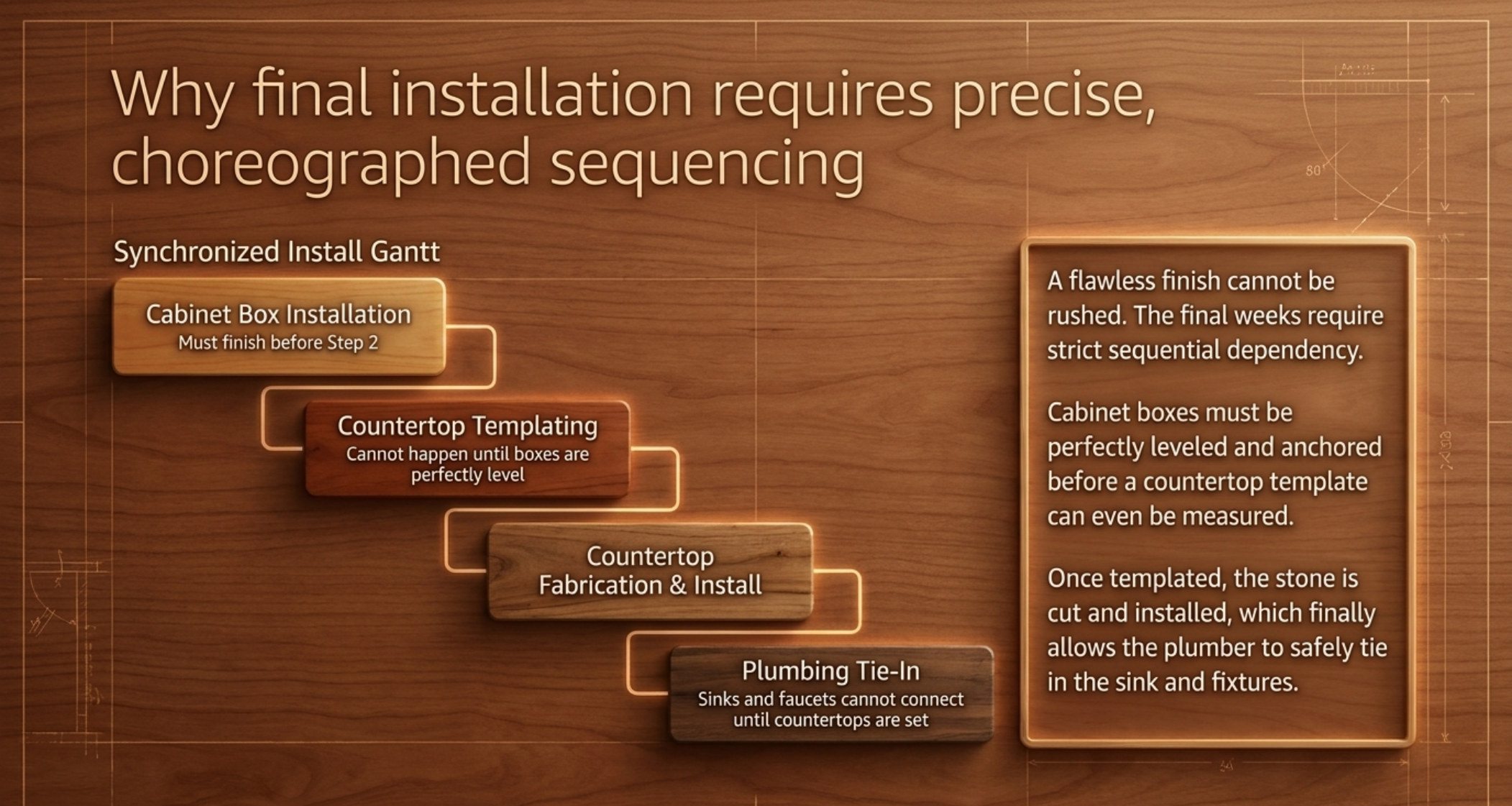
The final weeks of a cabinet project are not a job list; they are a chain. Cabinet boxes must be level and anchored before a countertop template can be measured. The template must exist before the stone can be cut. The stone must be set before the plumber can safely tie in the sink and fixtures. Each link depends on the one before it, and in an occupied Birmingham kitchen every compression of the chain is paid for again as rework. This is the phase where a well-specified project is either protected or quietly damaged.
| Step | Must finish before | Why the dependency exists | Typical duration |
|---|---|---|---|
| 1. Cabinet box installation | Step 2 | A template measured over unlevel boxes produces a slab that does not fit | 1–2 days |
| 2. Countertop templating | Step 3 | The slab is cut to the template; there is no second chance | A single site visit |
| 3. Countertop fabrication and install | Step 4 | Sinks and faucets cannot connect until the countertop is set | Several days including fabrication |
| 4. Plumbing tie-in | Project completion | The sink and fixtures seat into a finished surface | 1 day plus inspection if triggered |
Deck baseline: the sequence is drawn as a strict dependency chain because levelling is what the countertop depends on — not the schedule.
What breaks the chain, and what it costs
Three shortcuts appear on almost every troubled installer schedule. Boxes hung but not fully levelled so templating can happen a day early. Templating done before the boxes are anchored, so the run shifts. Plumbing rough-in pushed ahead of the stone to save a second visit, then disconnected and re-tied after the countertop lands. Each feels like a weekday saved and each produces a rework cost in the four figures, because the correction involves the most expensive trades on the job working out of sequence.
| Shortcut | Why it tempts the schedule | What it produces | Cost profile |
|---|---|---|---|
| Templating over unlevelled boxes | Buys one day on the schedule | A slab that does not sit flat; shimming or re-cutting | Four-figure rework and a delayed install |
| Boxes left unanchored through templating | Easier access around the run | Run shifts after the template is taken | Re-templating plus fabrication lead time lost |
| Plumbing tied in before the countertop | Avoids a return visit from the plumber | Disconnect and re-tie, with a water risk in between | Labour plus the risk of a leak under a new stone |
| Skipping the punch-list walkthrough | The crew has other jobs waiting | Doors and glides adjusted on your time later | A second call-out at minimum charge |
None of these are construction errors. They are sequencing errors, and they are all visible on a written schedule before the work starts.
Cost model: what a broken link costs per week
The deck prices a full custom kitchen at $10,000–$35,000 over 4–8 weeks. Divide the band by the calendar and a week of project duration is worth $1,250–$8,750 of installed work — $10,000 divided by 8 weeks at the low end, $35,000 divided by 4 weeks at the high end. That is the number to hold while a shortcut looks like it saves a weekday: a slip costs one day of every trade queued behind it, not one day of one trade.
Two lines show where the money moves. Refacing the same kitchen completes in 3–5 days instead of 4–8 weeks, a saving of roughly 15–37 working days of site time — the entire reason refacing is the schedule answer when the boxes are sound. Import duty rides along regardless of sequence: at the 2026 Section 232 tariff of 25% on imported wood products, a package with a third of its material imported carries about $833 of duty at the $10,000 end and about $2,917 at the $35,000 end.
Where the sequence itself costs money is the re-cut. Stone fabrication is quoted separately from cabinetry and the deck does not carry a figure for it, so treat any re-template as a second stone cycle plus a second plumbing visit, and get that number from your fabricator in writing before the template is booked. Nothing in the cabinet package is as expensive to redo as stone that was cut to a run that moved.
The permitting step that rides along in week seven or eight
Countertop and plumbing tie-ins frequently trigger local building permits, because they alter plumbing connections or structural elements of the kitchen. In Birmingham that means a permitting step that runs in parallel with installation and can gate the final inspection. Ask in advance who pulls the permit, who meets the inspector, and what happens if the inspection lands after the installers have left.
| Trigger | Who typically files | What it gates |
|---|---|---|
| Plumbing tie-in (sink, disposal, dishwasher) | The plumbing contractor on the project | Final connection and use of the kitchen |
| Structural change to a wall or opening | The general contractor or the homeowner | Continued work past the framing stage |
| Electrical work for new circuits or lighting | The electrical contractor | Inspection sign-off before finish work is closed in |
| Historic-district exterior-visible change | Whoever holds the contract (owner-led) | Design review before any exterior-visible element is ordered |
Deck baseline: countertop and plumbing tie-ins frequently trigger permits in Jefferson County — confirm current requirements locally before scheduling the install.
How to compress the schedule without breaking it
There is legitimate room to save time, and it does not involve skipping links. Pre-order the stone so fabrication starts the moment the template is taken. Have appliance specifications finalised before boxes are ordered so openings are cut once. Confirm the plumbing rough-in is complete and inspected before boxes go in, so the plumber's only visit after the stone is the connection. Stage the doors and drawer fronts in the shop so installation and hardware adjustment happen in one pass. Done that way, a local custom kitchen still finishes inside the 4–8 week band, and the sequence stays intact.
The two-week window that decides how the finished kitchen looks
Everything before installation is reversible. Templating is not. Once the stone is cut, the only variable left is how precisely the boxes were set — and that is why the two weeks between box installation and final plumbing tie-in determine whether the finished kitchen reads as custom or as assembled. The visible tells are all at the junction lines: a countertop that does not sit flat on the run, a filler that widens from end to end, a dishwasher opening that needed a shim. None of them are finish problems. All of them are levelling and anchoring problems from step one.
Protect those two weeks with three habits. Photograph the boxes after levelling but before the template is taken, so the state of the run is documented. Confirm in writing that templating will not be scheduled until anchoring is complete. And keep the punch list open through the plumbing tie-in rather than closing it at installation, because the final adjustments to doors and glides are made after the room stops being a construction site.
Decision matrix: choose the sequence, not the shortcut
- Choose refacing ($5,000–$17,500, 3–5 days) if the boxes are square and the layout works — the fastest legitimate finish, and it avoids templating altogether.
- Choose full custom ($10,000–$35,000, 4–8 weeks) if the boxes are failing or the layout has to change, and accept the chain as the price of the change.
- Choose to delay the template if the boxes are not yet anchored — a template taken early is a template taken twice.
- Choose the permit holder before the schedule is written if the project touches countertops or plumbing tie-ins: in Jefferson County those triggers commonly pull a permit that gates the final inspection, and the deck places it in week seven or eight.
- Choose furniture-grade built-ins (under $7,000) if you want storage with no plumbing or stone dependency at all — the shortest chain in the deck.
Spec handoff: the eight lines that protect the sequence
- A written schedule naming the four steps and the dependency between each pair.
- Boxes levelled and anchored, and photographed, before templating is booked.
- Confirmation in writing that the template date follows the anchoring date.
- Appliance specifications frozen before cabinet boxes are ordered, so openings are cut once.
- Plumbing rough-in complete and inspected before the boxes go in.
- Permit holder named, with who meets the inspector and on which day.
- The stone fabricator's re-template policy and price in writing.
- Punch list held open until the plumbing tie-in is finished, not closed at installation.
Planning a Birmingham kitchen? Call (205) 574-3205 for a free match with local custom cabinet professionals who sequence box installation, templating and plumbing tie-ins across Birmingham, Hoover and Jefferson County. No obligation.
Ready to Talk to a Local Cabinet Pro?
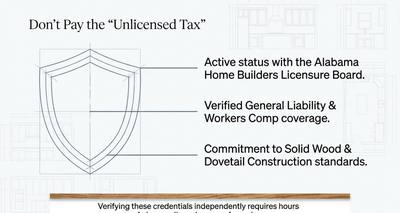
Get free, no-obligation quotes from pre-vetted Birmingham cabinet professionals — licensing, insurance and references checked before you are introduced.
Get Matched in Birmingham →