Verdict: four stressors, and only one of them is obvious
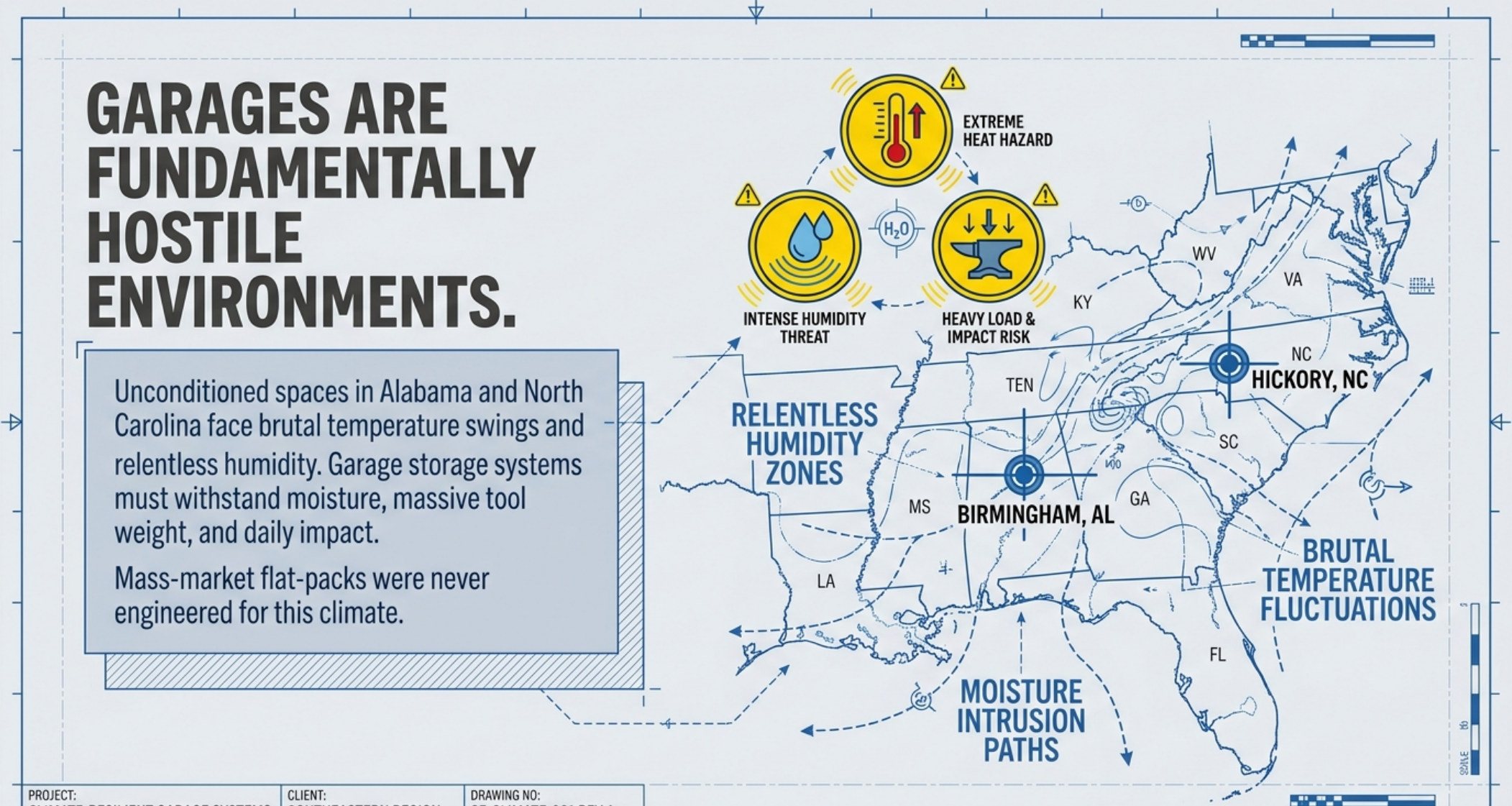
A Birmingham garage is not a room with cabinets in it. It is an unconditioned structure that swings through heat, cold and humidity with the seasons, holds water on the slab, and stores things that weigh more than anything in a kitchen. Four stressors run in parallel there, and inexpensive flat-pack storage systems are engineered for none of them. Understanding which one is killing a given unit is the difference between replacing a box every few years and never thinking about it again.
| Stressor | What it does through a Birmingham year | Failure mode in wood | Failure mode in thin metal |
|---|---|---|---|
| Relentless humidity | High summer moisture with slow drying | Edges swell, joints open, hinges lose purchase | Condensation on cool panels, then rust at fixing points |
| Brutal temperature swings | Hot days, cool nights, no conditioning | Repeated expansion and contraction works fasteners loose | Thermal ticking; coatings crack and expose bare steel |
| Heavy load | Automotive tools, fluids, seasonal gear | Thin shelves sag and stay bent under sustained load | Light-gauge frames buckle; floors deform |
| Impact risk | Lawn equipment, bikes, wheeled toolboxes | Failure is usually cosmetic if the panels are plywood | Dents that cannot be repaired and stay visible |
The deck baseline for a Southern garage is explicit: mass-market flat-packs were never engineered for this climate.
Two moisture paths do most of the damage
Humidity alone is survivable. Water that arrives through a path is what ends cabinets early. Two routes dominate in Birmingham: slab moisture moving into any panel that sits on the floor, and splash or hose water at the base of a run that has no sealed edge. Both attack the same vulnerability — an unfinished cut edge on particleboard or MDF — and both produce the same irreversible result.
| Moisture path | How it reaches the cabinet | Who is vulnerable | Mitigation |
|---|---|---|---|
| Slab moisture and floor pooling | Wicking from the garage floor after rain or washing | Any base unit set directly on the slab without legs or a sealed base | Legs or toe-kick on a sealed base; no composite within 1″ of the floor |
| Splash and hose water | Washing a car, washing the floor, weather blowing in | Base runs with unsealed cut edges and open sides | Seal all exposed edges; painted or laminate finished plywood |
| Humid air, all summer | Ambient moisture absorbed by porous panels | Particleboard and standard MDF boxes | Plywood boxes and kiln-dried hardwood fronts |
| Roof or gutter leaks above | Direct water onto the top of wall units | Top panels and anything stored on them | Fix the envelope first; a cabinet is not a waterproofing system |
What actually survives a Birmingham garage
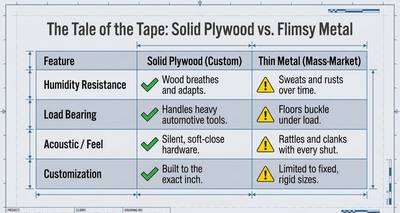
Two materials do the work. Plywood holds screws, resists sagging and does not disintegrate when an edge gets wet; kiln-dried hardwoods stay dimensionally stable through the humidity band. The hardwood of choice for garage-grade durability is the hardest domestic hardwood available, and kiln-dried maple and oak sit right behind it. The list of materials that fail is short and predictable.
| Material | Humidity resistance | Load bearing | Verdict for a garage |
|---|---|---|---|
| Solid plywood carcass | Wood breathes and adapts | Handles heavy automotive tools | The standard — specify 3/4″ and zero particleboard |
| Kiln-dried maple or oak fronts | Highly stable when dried below 10% moisture | Furniture-grade; takes impact without crumbling | Correct for doors, fronts and drawer boxes |
| Hardest domestic hardwood | Highly stable, dramatic grain | Highest impact resistance of any domestic species | Best where tools get thrown at the doors |
| Particleboard | Acts like a sponge; swells at exposed edges | Fails under sustained load | Never, in any garage zone |
| MDF | Fine in dry rooms; edges swell in wet zones | Hinges lose purchase when panels swell | Never within reach of a wet garage floor |
| Thin-gauge metal kits | Sweats and rusts over time | Floors buckle under load | Only where nothing heavy is ever stored |
The comparison that matters is not price at purchase — it is which of these is still square after ten summers.
Cost model: what the climate adds to a garage run
A garage run prices by the linear foot like any other cabinetry: about $150–$400 per linear foot for stock or RTA, $350–$650 for semi-custom and $500–$1,200 for full custom in an all-plywood carcass. Twelve linear feet therefore costs $1,800–$4,800 as RTA and $6,000–$14,400 as custom. That is the real trade against a mass-market metal or flat-pack system at around $400, because the cheap system does not delete the storage requirement — it re-sells it.
Run ten years rather than the invoice. A $400 kit that rusts through at the base in 2–4 years and is replaced once costs $800 before re-coating, and the second set of shelves needed when the first sags is a separate purchase. A custom plywood run at the low end of the band — $6,000 for 12 linear feet — carries the same load for the decade and is repaired rather than replaced when something does go wrong.
Two climate-driven lines deserve pricing explicitly. Slab water: any composite panel within an inch of the floor is a scheduled failure, and lifting the run onto legs or a sealed toe kick costs a fraction of replacing a door-and-front set. Import duty: the 2026 Section 232 tariff line is 25% on imported wood products, the class most knock-down garage kits fall into — a $1,800 RTA package that is a third imported carries about $150 of duty, and a fully imported package of the same size about $450, before a single shelf is loaded.
Load arithmetic: what a garage shelf actually carries
The load standard most cabinet line is judged against is 15 lb/sq ft of uniformly distributed load held for seven days, with deflection capped at 1/16 in per lineal foot and an absolute maximum of 1/4 in. Garages break that assumption because the load is neither uniform nor patient: a stack of oil jugs, a bench grinder and a case of fasteners sit in three separate concentrations, and they stay there for years. Sizing a shelf means converting your gear into pounds per square foot before you order, then derating anything that carries a point load.
| Item stored | Rough load | Typical footprint | Pressure on the shelf |
|---|---|---|---|
| Case of automotive fluids (12 qt) | 25–30 lb | 12″ × 18″ (1.5 sq ft) | Roughly 17–20 lb/sq ft — at or above the standard |
| Bench grinder or vice | 35–60 lb | 8″ × 12″ (0.7 sq ft) | A point load; needs a solid hardwood top, not a shelf |
| Boxed fasteners and hand tools | 40–70 lb | 14″ × 20″ (2 sq ft) | 20–35 lb/sq ft — more than double the standard |
| Seasonal gear, light and bulky | 10–20 lb | 24″ × 24″ (4 sq ft) | Well inside the standard; the easy load for plywood shelving |
Deck baseline thresholds are drawn from KCMA load and deflection tests for residential cabinetry; garage storage often exceeds them, which is why plywood and reinforced shelving are specified rather than assumed.
Designing for the climate instead of against it
Once the materials are right, layout finishes the job. Keep everything off the floor on legs or a sealed toe kick, keep composite panels away from slab moisture, and let air move behind and above the units so a garage can dry out overnight. Anchor wall units into stud framing rather than into drywall, and rate shelves for the load you intend to put on them — a shelf holding automotive fluids is a concentrated, sustained load, not a decorative one. Seal the cut edges of every panel you can see.
Decision matrix: choose the material and the mitigation
- Choose an all-plywood carcass if the unit sits on or near the slab, or anything stored on it can get wet — particleboard and MDF fail at the cut edge first, and that failure is irreversible.
- Choose kiln-dried solid hardwood fronts if the garage is unconditioned and the doors open daily; painted MDF edges swell in the wet months.
- Choose legs or a sealed toe kick if the slab shows any damp line — keeping composite an inch off the floor removes the dominant moisture path.
- Choose reinforced shelving if the load is concentrated, like fluids, fasteners or a bench grinder: the 15 lb/sq ft distributed standard does not describe a stack of oil jugs, and deflection is still capped at 1/16 in per lineal foot.
- Choose metal only if the space is conditioned and the loads are light — inside a climate-controlled room the condensation argument disappears and the price advantage stands.
Spec handoff: the eight lines for a climate-resilient garage run
- Carcass 100% solid plywood, zero particleboard, nothing composite within an inch of the slab.
- Fronts in kiln-dried hardwood with a moisture-resistant finish, not painted MDF.
- Drawer boxes in true dovetail joinery, never stapled or glued corners.
- Heavy-duty soft-close hardware and glides rated for tool weight, not kitchen weight.
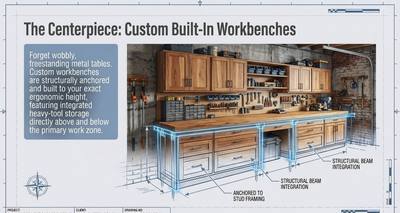
- Wall units anchored into stud framing through a solid-wood rail.
- Legs or a sealed toe kick at the base, with every visible cut edge sealed.
- Shelves rated for the load actually being stored, checked against 1/16 in deflection per lineal foot.
- Air movement behind and above the units so the garage can dry out overnight.
Planning garage or utility cabinetry in Birmingham? Call (205) 574-3205 and we will match you with local cabinet professionals who build climate-resilient garage systems across Birmingham, Hoover and Jefferson County. Free, and no obligation.
Ready to Talk to a Local Cabinet Pro?
Get free, no-obligation quotes from pre-vetted Birmingham cabinet professionals — licensing, insurance and references checked before you are introduced.
Get Matched in Birmingham →