Verdict: the build date is the trigger, not the paint condition
In a pre-1978 home — which describes most of Mountain Brook and Highland Park — any renovation that disturbs painted surfaces must follow lead-safe work practices. Cabinet removal disturbs painted surfaces by definition: faces come off, boxes are pried from walls, and dust is generated exactly where children and families live. The condition of the paint does not matter. The year the house was built does. That single fact reorders who can do the work, how the room is prepared and how the site is signed off, and it is the most commonly omitted compliance line in a Birmingham cabinet quote.
| Work item | Pre-1978 home | Post-1978 home |
|---|---|---|
| Who may perform removal | A certified firm using a certified renovator for the work area | Any competent crew |
| Site preparation | Work-area containment, sealed and taped, with floor protection beyond the work zone | Ordinary drop sheets and site protection |
| Work practices | Controlled removal methods that keep dust generation down; no uncontrolled sanding or dry-scraping of painted surfaces | Standard demolition practice |
| Clean-up and verification | Post-work cleaning with a documented verification step before the area is returned | Standard clean-up |
| Documentation | Certification and compliance records kept for the project | None required |
Deck baseline: federal lead-safe practice requirements apply to pre-1978 housing. Confirm current rules locally with your certified renovator before work starts.
What containment actually looks like in a kitchen removal
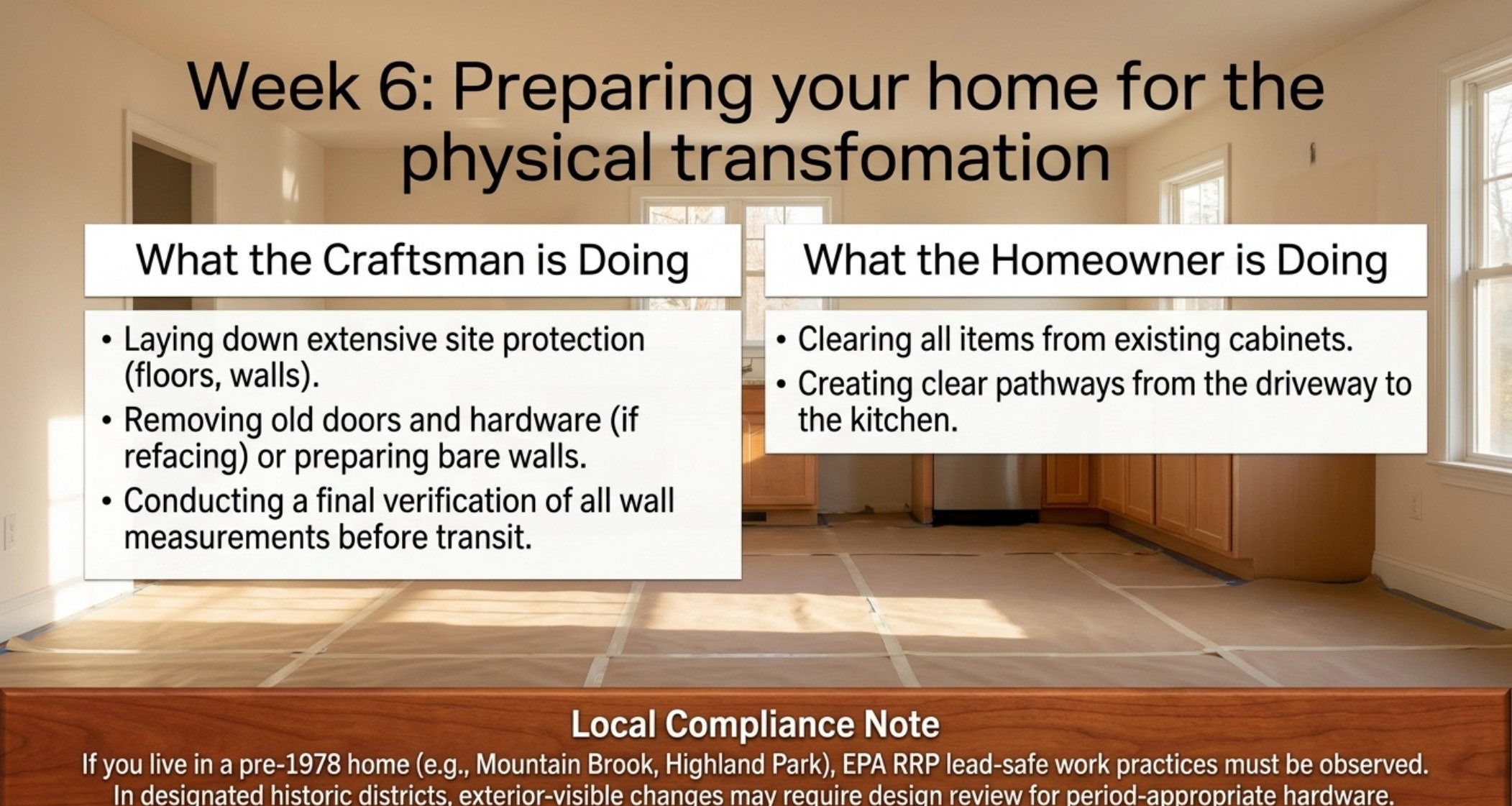
Containment is not a plastic sheet thrown over a doorway. It is a defined work area with a boundary that stays sealed for the duration, floor protection that extends beyond the cabinets, and a clean-up sequence that produces a documented result. The practical effect for a homeowner is that the kitchen stops being a room you can walk through while the work is happening — which is a scheduling fact, not a friction point. On a Birmingham cabinet project it typically adds about a day to the install-preparation phase and requires the household to plan around one blocked room.
| Phase | What happens | What the homeowner does |
|---|---|---|
| Before removal | Work area defined, containment installed, floor protection laid beyond the work zone | Clear the room completely and plan routing from the driveway in |
| During removal | Controlled removal, debris bagged and removed without re-entering the home | Stay out of the work area; keep pets and children clear |
| After removal | Interior cleaned with a documented verification step before containment comes down | Inspect the verified area before signing off |
| Install prep | Bare walls prepared; walls measured and confirmed before transit | Confirm appliance dimensions and layout decisions |
Specific containment distances and cleaning-verification methods are set by the lead-safe rule; your certified renovator states them for the project.
What it costs, and what it protects
Lead-safe work practices add cost in four places: certification, containment materials, additional labour hours and documented clean-up. The line items are small individually; together they are the reason an unlicensed bid on a pre-1978 Birmingham kitchen can look 15–30% cheaper. That saving is not margin — it is the compliance scope removed from the project. The federal maximum penalty for lead-safe violations runs to tens of thousands of dollars per day, per violation, on top of abatement costs if contamination is found after the fact, so the arithmetic only works one way.
| Cost line | Typical effect on a cabinet project | What it prevents |
|---|---|---|
| Certification and records | Administrative cost carried by the firm | An unaccountable work area in an occupied family home |
| Containment materials | Modest consumable cost | Dust migration into the rest of the house |
| Additional labour hours | Roughly a day added to install prep | Contamination of soft furnishings and HVAC |
| Cleaning verification | Documented post-work step | A resale or disclosure problem years later |
Treat the compliance scope as part of the specification: if it is not priced, it is not planned.
Cost model: the arithmetic of the compliance scope
The compliance scope is easiest to see as the gap between two bids. Unlicensed Birmingham installers quote 15%–30% under a licensed shop; on a $5,000–$15,000 reface that gap is $750–$4,500, and on a $10,000–$30,000 custom kitchen it is $1,500–$9,000. A licensed pre-1978 bid carries certification, containment materials, the extra labour hours the protocol adds and documented clean-up inside that difference — which is why the cheap bid is cheap.
Run the same arithmetic on the smallest scopes, because the trigger is the build year and not the size of the job. A $2,000–$6,000 period bathroom vanity carries a $300–$1,800 discount range, and a furniture-grade built-in under $7,000 carries $1,050–$2,100. Every one of those projects disturbs painted surfaces if the old unit comes out.
| Project scope | Deck band | 15% discount gap | 30% discount gap |
|---|---|---|---|
| Kitchen reface | $5,000–$15,000 | $750–$2,250 | $1,500–$4,500 |
| Full custom kitchen | $10,000–$30,000 | $1,500–$4,500 | $3,000–$9,000 |
| Period bathroom vanity | $2,000–$6,000 | $300–$900 | $600–$1,800 |
| Furniture-grade built-in | under $7,000 | about $1,050 | about $2,100 |
Derived from the deck's own project bands and the 15%–30% unlicensed discount range — planning arithmetic, not a quote.
The tariff line is separate and additive. 2026 Section 232 runs 25% on imported wood products, so imported doors or frames on a $10,000 package where a third is imported add about $833 of duty on top of the compliance scope, whatever protocol the job follows.
Why this matters after the job is finished
Lead-safe compliance is not only an in-progress concern. Records of the work become part of the home's history, and undisclosed or improperly handled renovation work in a pre-1978 home is a disclosure issue at resale in a way that an ordinary kitchen refresh is not. Birmingham's older neighbourhoods sell on their architecture, and the cabinetry that was installed correctly — with containment, verification and documentation — is easier to explain to a buyer than the alternative. If you cannot find the paper trail for a past removal, that is a question worth answering before you list, not during a negotiation.
How to find out whether your home is really pre-1978
The build year is not always obvious. County tax records give the assessed year, which can reflect a later renovation rather than the original structure; deed records and the local planning office can clarify; and an addition can predate or postdate the main house. When the record is ambiguous, the safe assumption is that lead-safe work practices apply — the cost of containment on a home that turns out to be post-1978 is far smaller than the cost of contaminating a pre-1978 home that was assumed to be newer. Ask the question before the crew is scheduled, not on the morning of demolition, because it changes who may do the work.
If you have had a previous renovation in the same house, check what was done. A prior kitchen or window project that generated documentation can establish both the build era and the prior handling of painted surfaces, and it tells a future buyer that the work in this house has been done with a paper trail. In Birmingham's older neighbourhoods that record is a genuine asset.
Decision matrix: choose the protocol before the crew is booked
- Choose lead-safe work practices if the home was built before 1978 — the year is the trigger and the paint condition does not change it.
- Choose the conservative assumption if the build year is unclear: containing a post-1978 home costs a fraction of contaminating a pre-1978 one.
- Choose refacing ($5,000–$15,000, 3–5 days) if the boxes are sound and the disturbance can be kept to doors and hardware rather than a full removal — the deck's refacing path keeps the existing boxes in place.
- Choose a full removal and replacement only if the boxes are failing or the layout is wrong; that is the scope that generates the most painted-surface dust and the one that most needs documented containment.
- Choose a licensed, insured renovator if the project is pre-1978 and the difference sits inside the 15%–30% gap — you are buying the paper trail as well as the labour.
Spec handoff: the seven lines for a pre-1978 removal
- Build year documented in the job file, from the best record available.
- Certified firm and certified renovator named on the quote, not just the licence number.
- The containment boundary and floor protection described in writing.
- Debris bagging and transport method named, including who removes it.
- Clean-up method stated, with the person who verifies it identified.
- Photographs before, during and after containment, kept with the job records.
Renovating a pre-1978 Birmingham home? Call (205) 574-3205 and we will match you with local cabinet professionals who work in period homes across Mountain Brook, Highland Park, Homewood and Jefferson County, with licensing and insurance verified first. Free, no obligation.
Ready to Talk to a Local Cabinet Pro?
Get free, no-obligation quotes from pre-vetted Birmingham cabinet professionals — licensing, insurance and references checked before you are introduced.
Get Matched in Birmingham →