Verdict: four layers, and only one of them is on public view
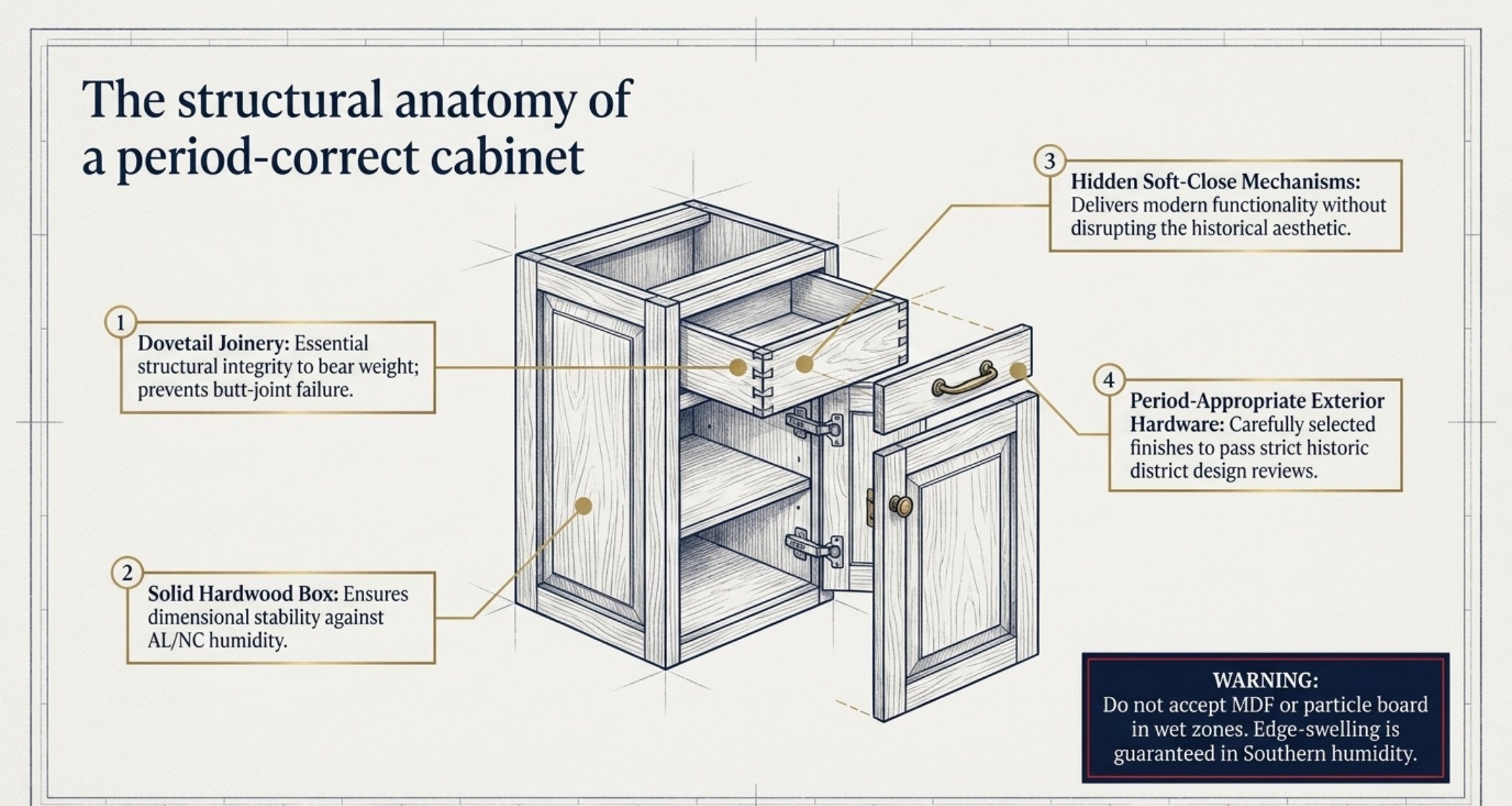
A period-correct cabinet is not a reproduction. It is a modern box wearing the right clothes. Four layers decide whether it satisfies a historic home in Mountain Brook or Highland Park and still survives an Alabama summer: the box, the joinery, the exterior hardware, and the hidden mechanisms that make it work in 2026. Design review only sees the outside. Your budget should be weighted toward the inside, because that is the half that fails first.
| Layer | Period-correct approach | Modern substitute that passes review | Share of cabinet spend |
|---|---|---|---|
| The box | 1.5″ solid-wood face frame on an all-plywood carcass | Plywood with a solid-wood hanging rail; no particleboard in wet zones | The largest single line — it is what the doors hang from for 30 years |
| The joinery | Mechanical dovetail drawer boxes | Precision-cut dovetails on a CNC; still interlocking pins and tails | Small line item; the most expensive one to get wrong |
| Exterior hardware | Finish and profile matched to the home’s era | Modern pulls in period finishes: unlacquered brass, nickel, oil-rubbed bronze | Per-unit cost; the line design reviewers actually discuss |
| Hidden mechanisms | Not historically present | Integrated soft-close hinges and under-mount full-extension glides | Baseline, not an upgrade — specify it in writing |
Layer-by-layer the rule is simple: modernise what nobody sees, preserve what the street sees.
What design review actually evaluates
Historic-district review focuses on exterior-visible change, not the carcass. In practice the review conversation is about four things, and only the first two are usually contested. Specific district requirements differ street by street — treat the list below as the deck baseline and confirm current rules locally with the authority having jurisdiction before you order hardware or cut a profile.
| Review subject | What reviewers look for | Cheapest way to satisfy it |
|---|---|---|
| Exterior hardware profile and finish | A finish and shape consistent with the home’s period | Period-profile pulls in a period finish — a finish change costs a few dollars a pull |
| Door and drawer front profile | Not a modern slab on a visible elevation | Shaker or raised-panel profiles that echo existing doors in the home |
| Visible materials | Painted or stained wood, not a composite edge | Painted hardwood fronts; reserve composite for concealed interiors only |
| Permanence of the change | That the alteration is reversible or consistent with the elevation | Keep the original face frame; change only what fastens to it |
Deck baseline — confirm current rules locally with your local design review staff before ordering.
Cost model: pricing the four layers
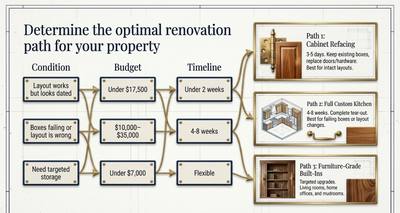
A period-correct kitchen lives inside the deck's $10,000–$30,000 full custom band over 4–8 weeks, or the $5,000–$15,000 refacing band over 3–5 days when the boxes are sound — roughly half of replacement. Two smaller scopes cover the rest of a period home: a period-styled vanity at $2,000–$6,000 and targeted furniture-grade built-ins under $7,000 on a flexible schedule. Read the spend by layer and the decision becomes explicit: the box and the joinery are the load path and the moisture defence, while the visible face design review evaluates is the cheapest layer to change later.
Species is the one material line with a price tier attached. Kiln-dried maple and oak sit in the mid tier, cherry a step above and walnut at the premium end, with the most dimensionally stable rustic hardwood available also priced in the mid tier. Buying one tier down and spending the difference on dovetail drawer boxes and soft-close hardware is the trade that survives the decade; the reverse — premium faces over a composite carcass — is the one an inspector or a buyer eventually finds.
Then the import line. 2026 Section 232 applies 25% to imported wood products, so a package specifying imported profiles and mouldings carries duty a domestic shop does not: on a $12,000 order with a third imported, about $1,000. Name the origin on the quote before the profiles are cut.
The one material warning that never expires
Do not accept MDF or particleboard in wet zones. In Southern humidity, edge swelling is not a risk — it is a scheduled event. The failure sequence is predictable: the cut edge absorbs moisture, the panel swells and loses its dimensions, the finish film breaks along the swelling line, and the hinge plate begins to move. Once that starts, the only repair is replacement, and paint cannot conceal it because paint is not a structural material.
| Component | Composite panel behaviour | Solid hardwood behaviour | Correction cost if it fails |
|---|---|---|---|
| Sink base | Swelling within seasons; interior finish lifts | Stable all year at under 10% moisture content | Full base-cabinet replacement plus countertop reset |
| Dishwasher bay | Heat plus moisture accelerates swelling | Holds screws and dimension | Base run rebuilt; plumbing re-tied |
| Tall pantry near a mop zone | Edge swelling along the toe kick | Kiln-dried stock stays dimensionally stable | Door and box replacement |
| Visible door front | Painted composite edges show first | Painted hardwood wears but does not swell | Refinishing, not replacement |
Local calibration: the stock is not one period
Birmingham's historic neighbourhoods were built across several decades, so "period-correct" is address-specific rather than neighbourhood-specific. A 1920s bungalow and a 1960s ranch two streets apart can need different door profiles, different hardware finishes and different sheen levels, and the same kitchen can contain an original 1930s section and a 1990s addition that was never matched to it. The practical method is to survey the house rather than the district: photograph every original door, drawer front and piece of hardware, note the finish sheen on the existing trim, measure the existing door thickness, and build the specification around the dominant original. In period homes the visible layer is what a buyer reads first — a mid-century pull on a 1920s door is legible from the doorway, and it is the cheapest mistake in the project to avoid and the most expensive to undo once the fronts are drilled and finished.
What a period-correct project costs in Birmingham
Three scopes cover almost every historic-home cabinetry job. Targeted furniture-grade built-ins start under $7,000 with a flexible schedule, which is why they are the usual first move in a period home. A custom bathroom vanity in a period style runs $2,000–$6,000. A full custom kitchen runs $10,000–$30,000 over 4–8 weeks, and refacing the same kitchen lands near $5,000–$15,000 in 3–5 days when the existing boxes are sound.
The trade-off is always the same: money spent on the visible layer is recoverable at resale because a buyer sees it, while money spent on the box and joinery is invisible until it is absent. Homes in Mountain Brook and Highland Park are judged on both, and the second one is what a home inspector writes down.
One more arithmetic note on the same comparison: a reface is capped by the size and condition of the existing run, so its cost is essentially fixed once the linear footage is known, while a built-in scales with what you choose to add. That makes built-ins the more controllable of the two budgets. Specify the alcove first, price the box and face detail second, and treat lighting, outlets and integrated accessories as optional additions that can be deferred to a second phase without redoing the first.
Decision matrix: choose the layer to spend on
- Choose modern hidden mechanisms if the change is invisible from the street — soft-close hinges and full-extension glides pass review and are the functional upgrade a period home actually needs.
- Choose period-appropriate exterior hardware if the door fronts are visible on a public elevation; that is the layer design review evaluates.
- Choose kiln-dried maple or oak if the kitchen is painted or traditionally stained and the grain should read quietly, and the rustic-grade stable domestic hardwood if the grain is meant to dominate.
- Choose cherry or walnut if the room is formal or modern and the budget carries the upper tiers — with the carcass still specified in plywood.
- Choose refacing ($5,000–$15,000) if the period boxes are sound, and full custom ($10,000–$30,000) if they are not; the visible result differs far less than the invoice.
Species and stability matrix
| Species | Humidity stability | Price tier | Best period or kitchen style |
|---|---|---|---|
| Maple | Excellent when kiln-dried | Mid | Painted period kitchens, light tone |
| Oak | Excellent | Mid | Traditional and stained kitchens, classic grain |
| Cherry | Moderate | Upper | Period and formal rooms; darkens with age |
| Walnut | High | Premium | Modern luxury, rich dark tone |
Deck baseline by species. Kiln-dried stock is the requirement, not a preference — state the species and drying standard on the quote.
Spec handoff: the eight lines for a period-correct job
- A survey of original door profiles, drawer fronts, hardware finishes and trim sheen, photographed.
- Plywood carcasses and solid hardwood boxes, with no MDF or particleboard in wet zones.
- Dovetail drawer boxes specified by name rather than assumed.
- Period-appropriate exterior hardware, matched to the survey and named by finish.
- Kiln-dried stock with the drying standard stated on the quote.
- The design-review submission itemising every exterior-visible change.
Planning cabinetry for a historic Birmingham home? Call (205) 574-3205 and we will match you with local custom cabinet professionals who work in period homes across Mountain Brook, Highland Park and Jefferson County — licensing, insurance and references verified first. Free, no obligation.
Ready to Talk to a Local Cabinet Pro?
Get free, no-obligation quotes from pre-vetted Birmingham cabinet professionals — licensing, insurance and references checked before you are introduced.
Get Matched in Birmingham →