Verdict: metal wins the invoice, plywood wins the decade
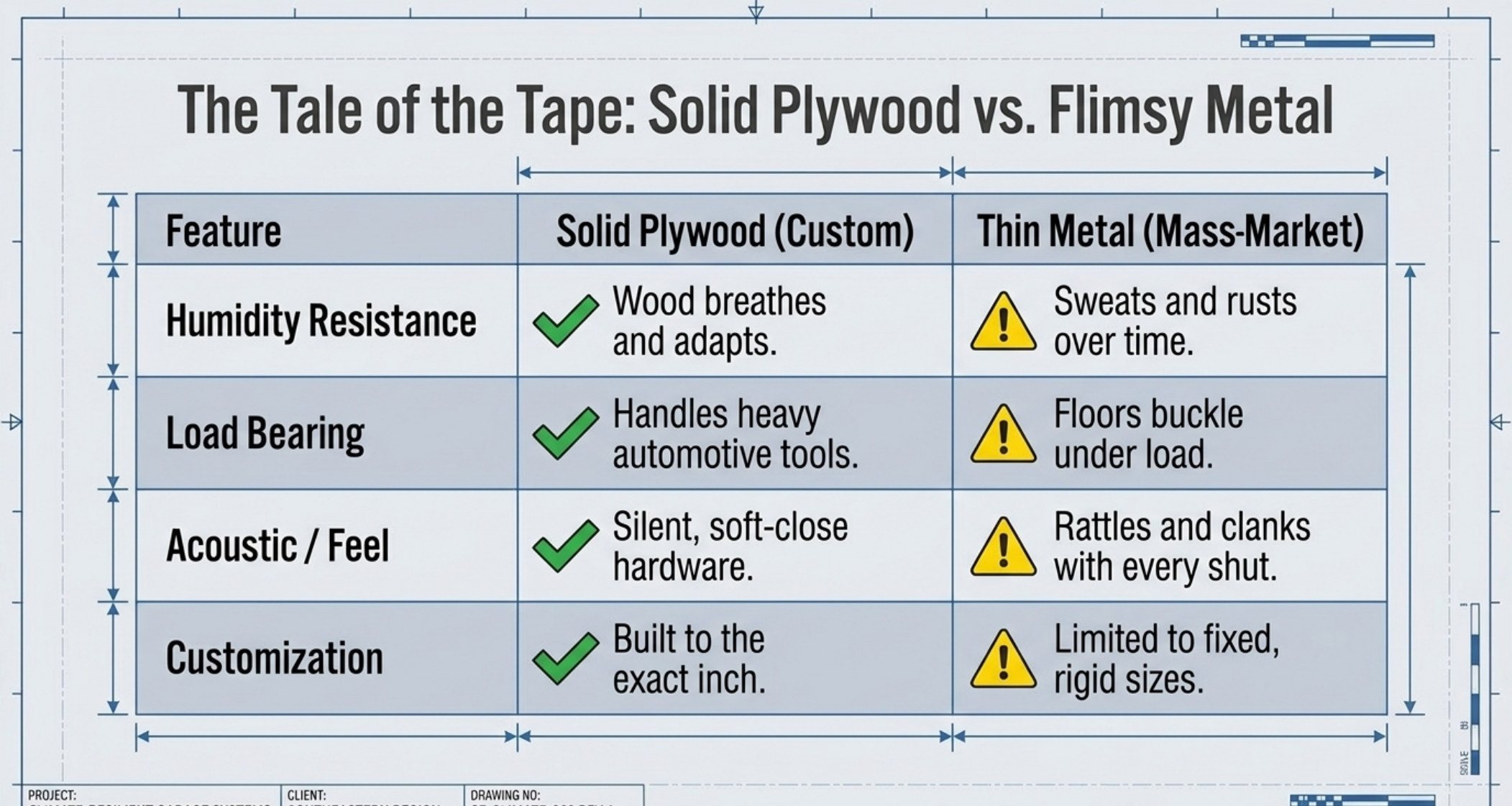
The comparison is not close once you stop pricing at purchase. Thin-gauge metal storage and a solid plywood garage cabinet differ on four measurable axes — humidity behaviour, load bearing, acoustic feel and how closely the unit fits the room — and metal wins only the last one on price. A steel kit is cheaper on day one and more expensive across ten Birmingham summers, because every one of those axes resolves in the same direction once the garage is unconditioned and the shelves are loaded.
| Axis | Solid plywood (custom) | Thin metal (mass-market kit) |
|---|---|---|
| Humidity resistance | Wood breathes and adapts; no corrosion path | Sweats on cool panels and rusts over time |
| Load bearing | Handles heavy automotive tools; shelf deflection stays inside tolerance | Floors buckle under load and stay deformed |
| Acoustic and feel | Silent, soft-close hardware; doors shut without noise | Rattles and clanks with every movement |
| Customisation | Built to the exact inch — no dead zones | Limited to fixed, rigid sizes that waste wall length |
Deck baseline: on every one of these four axes, the engineered plywood unit is the durable answer and the metal kit is the price answer.
Why metal is the wrong material for an unconditioned garage
Metal fails in a garage for thermodynamic reasons, not for want of quality. An unconditioned Alabama garage warms and cools through a wide daily band, and a large steel surface that cools faster than the humid air around it collects condensation on the flat panels. Condensation is the delivery mechanism; rust is what happens after. Once rust starts at a fixing point, the panel loses section exactly where the load is carried, so the failure progresses from cosmetic to structural. A dented panel in the same unit cannot be repaired — it can only be lived with, which is why metal kits tend to be replaced rather than maintained.
| Failure | Mechanism | Time to appear in a Birmingham garage | Repair path |
|---|---|---|---|
| Surface rust at fixings | Condensation on cool panels | First humid season in an unconditioned garage | Sand and repaint — until the coating fails again |
| Rust-through at base | Water pooling and wicking at the floor line | 2–4 years where the slab stays damp | Panel replacement; usually uneconomic |
| Bent shelf floor | Sustained load above the light-gauge rating | Immediately, and permanently | None — the floor does not spring back |
| Rattle and resonance | Thin panels with no mass damping | From installation | None — it is a property of the material |
The plywood equivalent fails differently: it can be sanded, re-finished or re-fitted, which is why the replacement cycle is longer.
The ten-year cost of each decision
Homeowners comparing a $400 steel kit against a custom plywood run rarely extend the comparison past year one. Extend it, and the arithmetic flips. Even without a total failure, the metal route accumulates replacement and re-coating work, while the plywood route accumulates almost nothing. Add the load-capacity limit and you also pay twice for storage: once for the unit and again for the second set of shelves you need when the first set sags.
| Line item | Thin metal kit (10 years) | Custom plywood cabinets (10 years) |
|---|---|---|
| Initial purchase | Lowest upfront | Higher upfront — 3/4″ plywood carcass, solid-wood faces |
| Replacement or repair | Rust treatment, shelf replacement, likely one full replacement | Touch-up and hardware adjustment only |
| Effective load capacity | Light — heavier loads need a second system | Rated for automotive tools; one system, sized once |
| Fit to the room | Fixed sizes leave dead zones you still paid for | Built to the inch; every linear foot used |
Deck baseline arithmetic only — exact figures depend on the run length and the load being stored.
Cost model: the ten-year arithmetic with real bands
Price the two routes by the linear foot. A 12-foot garage run at the installed bands is $1,800–$4,800 as stock or RTA, $4,200–$7,800 as semi-custom and $6,000–$14,400 as full custom in an all-plywood carcass. The metal kit is around $400, and that is where comparisons stop — but the same 12 feet still needs upper storage and drawer capacity, so the honest comparison is the kit plus the storage it forces you to buy afterwards.
Extend it across ten years and the totals converge. A kit that rusts through at the base in 2–4 years is replaced once at $400 before re-coating, and a shelf floor loaded past its light-gauge rating stays deformed, so the replacement shelf is a second purchase. The plywood route pays the $6,000 upfront at 12 linear feet and then accumulates hardware adjustment. The difference over ten years is not the purchase price — it is how many times each route is bought.
The tariff line sits on top of both. 2026 Section 232 applies 25% to imported wood products, the material class of most knock-down kits, so a $1,800 RTA package that is a third imported carries about $150 of duty and a fully imported package of the same size about $450. A domestic plywood shop quotes the same run without that line.
What to write into a garage cabinet specification
Whether you buy or build, the specification decides the outcome. Five lines carry almost all of the difference between a garage system that is still square in 2036 and one that has been replaced twice:
- Box: 100% solid plywood, zero particleboard. Nothing composite within an inch of the slab.
- Fronts: kiln-dried hardwood with a moisture-resistant finish — not painted MDF, whose edges swell in wet zones.
- Drawers: true dovetail joinery, not stapled or glued corners that blow out under tool weight.
- Hardware: heavy-duty soft-close hinges and under-mount full-extension glides rated for the load, not for a kitchen cabinet.
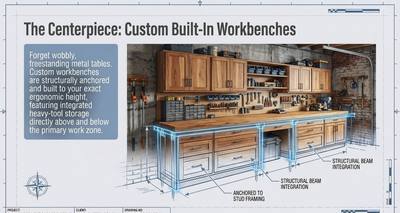
- Fixings: wall units anchored into stud framing, not into drywall or a metal panel.
Get those five stated on the quote and you have separated the two products before either is installed. On cost, garage or utility cabinetry follows the same installed band as the rest of the house — roughly $150–$400 per linear foot for stock or RTA, $350–$650 for semi-custom and $500–$1,200 for full custom — with the tariff line of 25% on imported wood products adding to any non-domestic package.
Where you can legitimately save money in a garage build
Choosing plywood over metal does not mean choosing the most expensive version of every component. Three substitutions are honest savings. First, keep the run to base cabinets plus a single tall locker instead of full-height uppers — wall units cost the same per linear foot as base units but carry shelf loads that rarely need cabinet-grade construction. Second, use painted plywood fronts instead of hardwood doors where nothing heavy is thrown at them, and reserve solid hardwood for the workbench zone. Third, plan the run in one order rather than two phases: fabrication and installation are the fixed costs, and repeating either for an expansion costs more than doing it once.
Three substitutions are not honest savings, and they are the ones a cheap garage quote reaches for first: particleboard boxes, glued or stapled drawer joints, and unbranded glides rated for a kitchen rather than a toolbox. Each saves a few hundred dollars at purchase and each produces a failure inside five years in an unconditioned garage. The rule is the same one the deck applies to kitchens: buy the structure, economise on the surfaces.
Decision matrix: choose the material for the room you have
- Choose solid plywood if the garage is unconditioned and heavy tools live on the shelves — condensation, rust-through at fixings and buckling all start in the first humid season.
- Choose the RTA band ($150–$400 per linear foot) if the load is light and the panels can be kept an inch off the slab with every cut edge sealed; custom plywood ($500–$1,200 per linear foot) if the run passes about 10 feet or carries automotive weight.
Maintenance and replacement truth table
| Watch item | Thin metal kit | Solid plywood cabinet | Check interval |
|---|---|---|---|
| Base panel at the slab | Rusts through in 2–4 years where the slab stays damp | Edge swelling only if the panel sits on the floor | Annually, after the wet season |
| Shelf floor under load | Permanently deformed above the light-gauge rating | Deflects and springs back within 1/16 in per lineal foot | Whenever the stored load changes |
| Surface at the fixings | Rust starts at the fixing points, where the load is carried | No corrosion path | Once per humid season |
| Noise and straightness | Rattles from installation; deformed panels cannot be straightened | Doors and glides adjustable; touch-up only | Annually |
Intervals are planning assumptions; the 1/16 in per lineal foot deflection threshold is the deck's own.
Spec handoff: the five lines for a garage run
- All-plywood carcass, zero particleboard, nothing composite within an inch of the slab.
- Dovetail drawer boxes and load-rated full-extension glides.
- Wall units anchored into stud framing through a solid-wood rail, never into drywall.
- The manufacturing origin named on the quote, for the tariff line.
Comparing quotes for a Birmingham garage? Call (205) 574-3205 and we will match you with local cabinet professionals who build solid plywood garage systems across Birmingham, Hoover, Trussville and Jefferson County. Free, no obligation.
Ready to Talk to a Local Cabinet Pro?
Get free, no-obligation quotes from pre-vetted Birmingham cabinet professionals — licensing, insurance and references checked before you are introduced.
Get Matched in Birmingham →