Verdict: the brief changes with the housing stock, not the budget
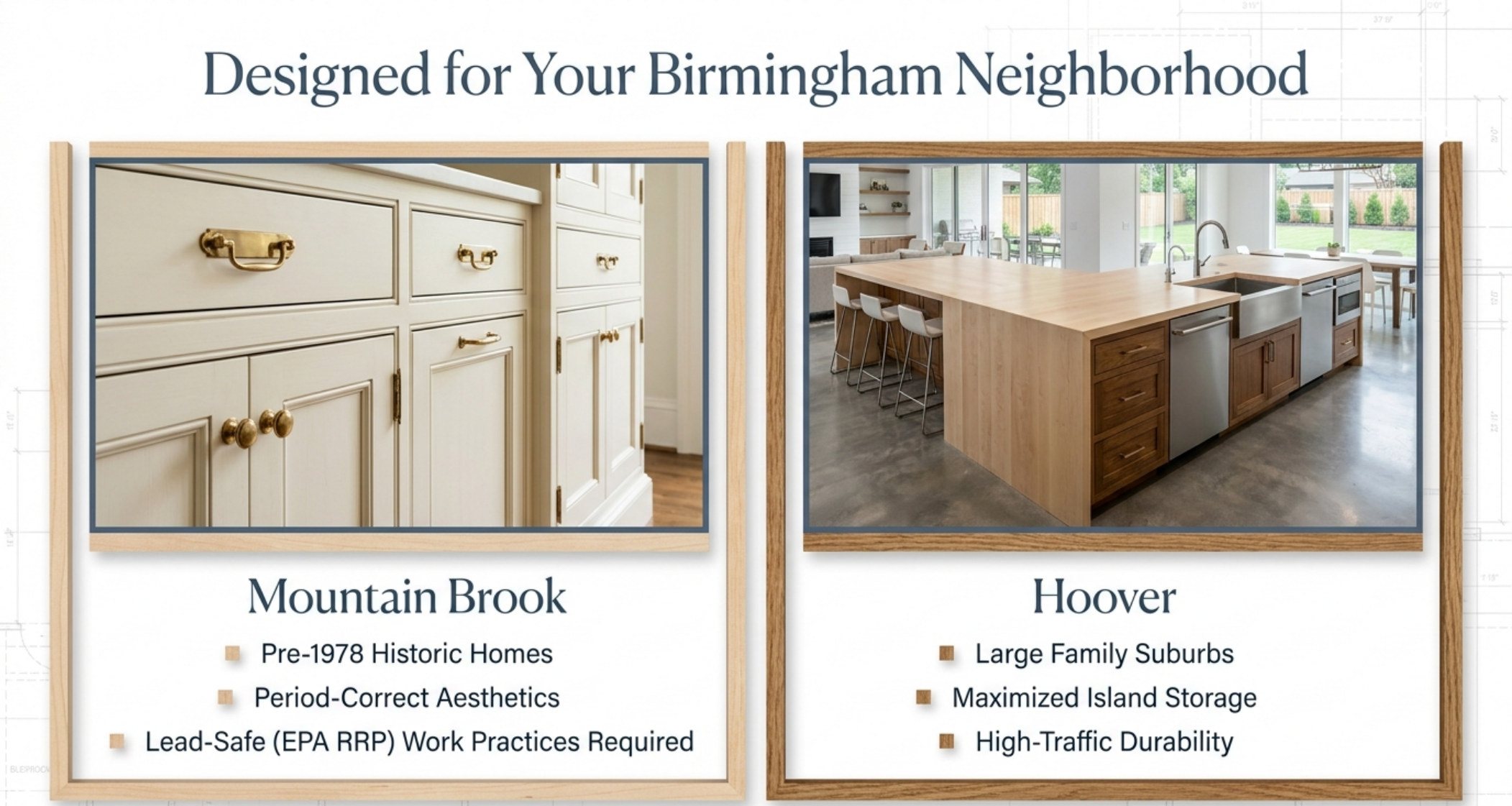
Two Birmingham kitchens can carry the same $10,000–$30,000 custom cabinetry budget and still need completely different specifications. In Mountain Brook and Highland Park the driver is a pre-1978 structure: period-correct door profiles, period-appropriate hardware, and lead-safe work practices during removal. In Hoover, Vestavia Hills, Homewood and Trussville the driver is traffic — how many hands touch the doors each day, and how much weight the island has to hold. Cabinetry runs 29%–35% of a kitchen renovation budget, so getting the brief wrong is the most expensive mistake available to you.
| Neighbourhood | Housing stock | Primary driver | Door and finish brief |
|---|---|---|---|
| Mountain Brook | Predominantly pre-1978 | Period-correct aesthetics; lead-safe removal under EPA RRP | Painted or stained hardwood in period profiles, matched to existing millwork |
| Highland Park | Predominantly pre-1978 | Same brief, tighter room geometry | Shallower boxes, period hardware, hidden soft-close mechanisms |
| Hoover | Mostly post-1990 family homes | High-traffic durability; maximised island storage | Painted shaker or slab fronts, wipe-clean finish, heavy-duty soft-close |
| Vestavia Hills | Mixed 1960s–2000s | Layout efficiency and storage where the walls are | Transitional stained hardwood, full-extension glides |
| Homewood | Mixed, denser lots | Small-footprint storage gains | Tall pantry boxes, depth-managed built-ins |
| Trussville | Newer build stock | Island-centric family kitchens | Island rated for drawer load and seating overhang |
The four decisions that actually differ
The two briefs diverge on four specification lines that move money between boxes, doors, hardware and compliance. Nothing else on the quote changes much.
| Specification | Pre-1978 brief (Mountain Brook, Highland Park) | Suburban brief (Hoover, Vestavia, Trussville) | Cost effect |
|---|---|---|---|
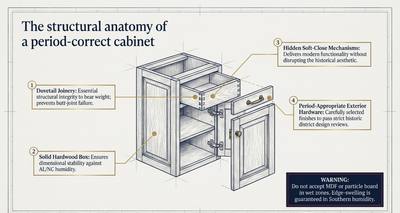
| Box material | Kiln-dried solid hardwood frames, all-plywood boxes | All-plywood boxes, kiln-dried hardwood stock | Kiln-dried and plywood construction carries 0% tariff exposure; imported lines do not |
| Door profile | Weighed against existing millwork and any district design review | Shaker or slab; durability beats profile accuracy | Custom profiles mostly buy lead time, not cost |
| Hardware | Period appearance with hidden soft-close mechanisms underneath | Soft-close hinges and under-mount full-extension glides as baseline | Soft-close specified as baseline, not an upgrade — if it is optional the quote is incomplete |
| Removal protocol | EPA RRP lead-safe work practices: certified firm and certified renovator | Standard dust control and site protection | Containment and cleaning verification add roughly one day to install prep |
Cost effects are relative, not absolute — box construction and compliance protocol move the total more than profile choice does.
Why the pre-1978 line is a hard threshold
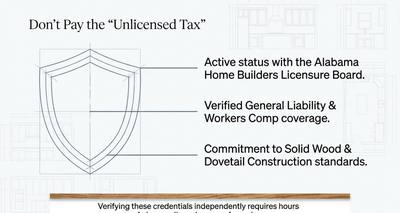
A pre-1978 build date triggers lead-safe work practices on any renovation that disturbs painted surfaces, and cabinet removal is exactly that. In Mountain Brook and Highland Park, where the stock is largely pre-1978, this changes who can legally do the work (a certified firm using a certified renovator), how the room is contained, how debris is bagged, and how the site is cleaned and verified. It is a compliance line rather than a selling point, and it is the one line item that never appears on a bid from an unlicensed installer. Verify licensure against the Alabama Home Builders Licensure Board record before deposit, not after demolition.
Why the suburban brief is a load problem
Family-suburb kitchens fail at the island and the sink run, not at the wall cabinets. Those units carry the heaviest loads and see the most moisture. Specify boxes that hold screws, drawer bottoms that survive a 3 lb steel ball dropped 6 in, shelf deflection capped at 1/16 in per lineal foot (absolute maximum 1/4 in) under a 15 lb/sq ft load, and glides rated for the cycles a real household produces. A pantry with a soft-close door and a cheap drawer box is a drawer box that racks within two seasons of Alabama humidity.
| Failure point | What it sees in a Hoover kitchen | Specification that survives it | What a cheap spec does instead |
|---|---|---|---|
| Island drawers | Pans, appliances, daily cycling | Dovetail drawer boxes, under-mount full-extension glides, 15 lb/sq ft rating | Stapled corners and glides rated for occasional use |
| Sink base | Standing moisture, detergent, spill pooling | Plywood box with sealed interior; kiln-dried hardwood frame | Particleboard swelling at the cut edges |
| Wall cabinets | Stacked plates and glassware | Solid-wood hanging rail carrying load to the studs | 1/8″ fibreboard back taking the load instead of the studs |
| Door edges in humid months | Repeated wipe-downs | Wood or solid-core fronts; seamed doors must pass the 4-hour detergent test | Painted MDF with exposed edges |
Cost model: the arithmetic that separates the two briefs
The deck's dollar bands and the installed per-linear-foot bands reconcile the moment you fix the run length. At $500–$1,200 per linear foot installed, a 20-foot run lands exactly at the bottom of the deck's $10,000–$30,000 kitchen band and a 25-foot run lands at the top. That is the whole budget argument in one line: this is a per-foot decision, and every line item that follows is priced per foot of run.
Three deltas move the number between neighbourhoods. Compliance: an unlicensed bid on a pre-1978 house typically lands 15%–30% under a licensed shop, which is $1,500–$3,000 on a $10,000 package and $4,500–$9,000 on a $30,000 package; that gap is the licence, the insurance and the lead-safe protocol removed from the scope, not margin. Specification: moving a box from the stock band ($150–$400 per foot) to an all-plywood carcass with dovetail drawer boxes ($500–$1,200 per foot) is a $350–$800 per-foot decision, and a 20-foot run multiplies it by twenty. Origin: the 2026 Section 232 tariff line runs 25% on imported wood products, so a package with a third of its material imported carries about $833 of duty at $10,000 and about $2,500 at $30,000. Those three lines, not the door profile, decide the total.
Alabama humidity is the spec writer nobody invoices
Birmingham sits in a summer humidity band that punishes every cut edge and every pocket of standing air. The practical threshold is written into the material standard: solid and composite stock should be kiln-dried to 10% moisture content or less before fabrication, and boxes should be plywood rather than particleboard. Anything above that moisture line keeps moving after install — doors drift out of alignment in August and back in November, and painted MDF edges swell where the finish film breaks at a joint. It is a slow, cheap-looking failure that costs a full door-and-front replacement to correct.
| Material | Humidity behaviour in a Birmingham summer | Where it belongs | Where it fails |
|---|---|---|---|
| Kiln-dried maple | Very stable; takes paint cleanly | Painted kitchens in any neighbourhood | Careless edge sealing on painted doors |
| Kiln-dried oak | Very stable; prominent grain | Traditional and stained kitchens | Unfinished edges in wet zones |
| Cherry | Moderate stability; darkens with age | Period and formal kitchens | Wants a stable interior; avoid wet zones |
| Walnut | Highly stable; rich dark tone | Modern luxury kitchens | Premium price tier |
| Particleboard | Acts like a sponge; edges swell and warp | Nowhere in a wet zone | Sink bases, dishwasher bays, garage floors |
| MDF | Edges swell in wet zones; hinges lose purchase | Painted doors in dry rooms, at a price | Anything within reach of a leak or a mop |
The deck baseline is under 10% moisture content at fabrication; ask the shop to state the species and the drying standard on the quote.
Book the right brief before the first measurement
Decide which Birmingham you are renovating in before anyone measures. If the home predates 1978, confirm lead-safe protocol and licensure first. If it does not, put the budget where load and moisture actually land: boxes, drawer boxes, glide ratings and a sealed plywood sink base. Either way, get an itemised quote that separates materials from labour and names the manufacturing origin — a 2026 Section 232 tariff line (25% base on imported wood products, approaching 46% combined out of major import hubs) can move a cabinet package by hundreds of dollars with no change in scope.
Decision matrix: choose the brief before the first measurement
- Choose the pre-1978 brief if the structure predates 1978 — in Mountain Brook and Highland Park the containment, certified renovation and period-appropriate hardware are mandatory scope, and the licensed bid that carries them is cheaper over the life of the house.
- Choose the suburban load brief if the kitchen carries more than about four people on a normal day, or the island is the primary work surface — spend on drawer boxes, glide ratings and a sealed plywood sink base, not on a decorative profile.
- Choose refacing ($5,000–$15,000, 3–5 days) if the boxes are square and the layout works; choose full custom ($10,000–$30,000, 4–8 weeks) if they are failing or the plan is wrong. No brief rescues a bad layout.
- Choose furniture-grade built-ins (under $7,000, flexible schedule) if the kitchen is sound and the shortage is storage elsewhere in the house — it is the cheapest capacity per dollar on the deck.
Spec handoff: the eight lines to put in front of a contractor
- Build year confirmed in writing, with the lead-safe protocol named if the home is pre-1978.
- Carcass 100% plywood, no particleboard, and nothing composite within an inch of a wet zone.
- Stock at fabrication: under 10% moisture content, with the species and drying standard stated on the quote.
- Drawer boxes in true dovetail joinery, never stapled or glued corners.
- Shelf deflection under a 15 lb/sq ft load capped at 1/16 in per lineal foot, 1/4 in absolute maximum.
- Soft-close hinges and full-extension glides rated for the load, not for a showroom.
- Wall units anchored into stud framing through a solid-wood hanging rail, never into drywall.
- Itemised quote separating materials from labour, with the manufacturing origin named for the tariff line.
Custom cabinetry in these neighbourhoods typically runs $10,000–$30,000 for a kitchen and $2,000–$6,000 for a bathroom vanity, with refacing landing near half the replacement figure when the existing boxes are sound. Call (205) 574-3205 to talk through which brief fits your address, or get matched free with local Birmingham cabinet professionals — no obligation.
Ready to Talk to a Local Cabinet Pro?
Get free, no-obligation quotes from pre-vetted Birmingham cabinet professionals — licensing, insurance and references checked before you are introduced.
Get Matched in Birmingham →